

How to Scale HR Globally: An OutSail Conversation with Teamtailor CHRO Sarah Mian
Sarah Mian, Teamtailor CHRO, sat down with Brett Ungashick, Founder of OutSail, to see what it really takes to scale HR globally with a lean team.

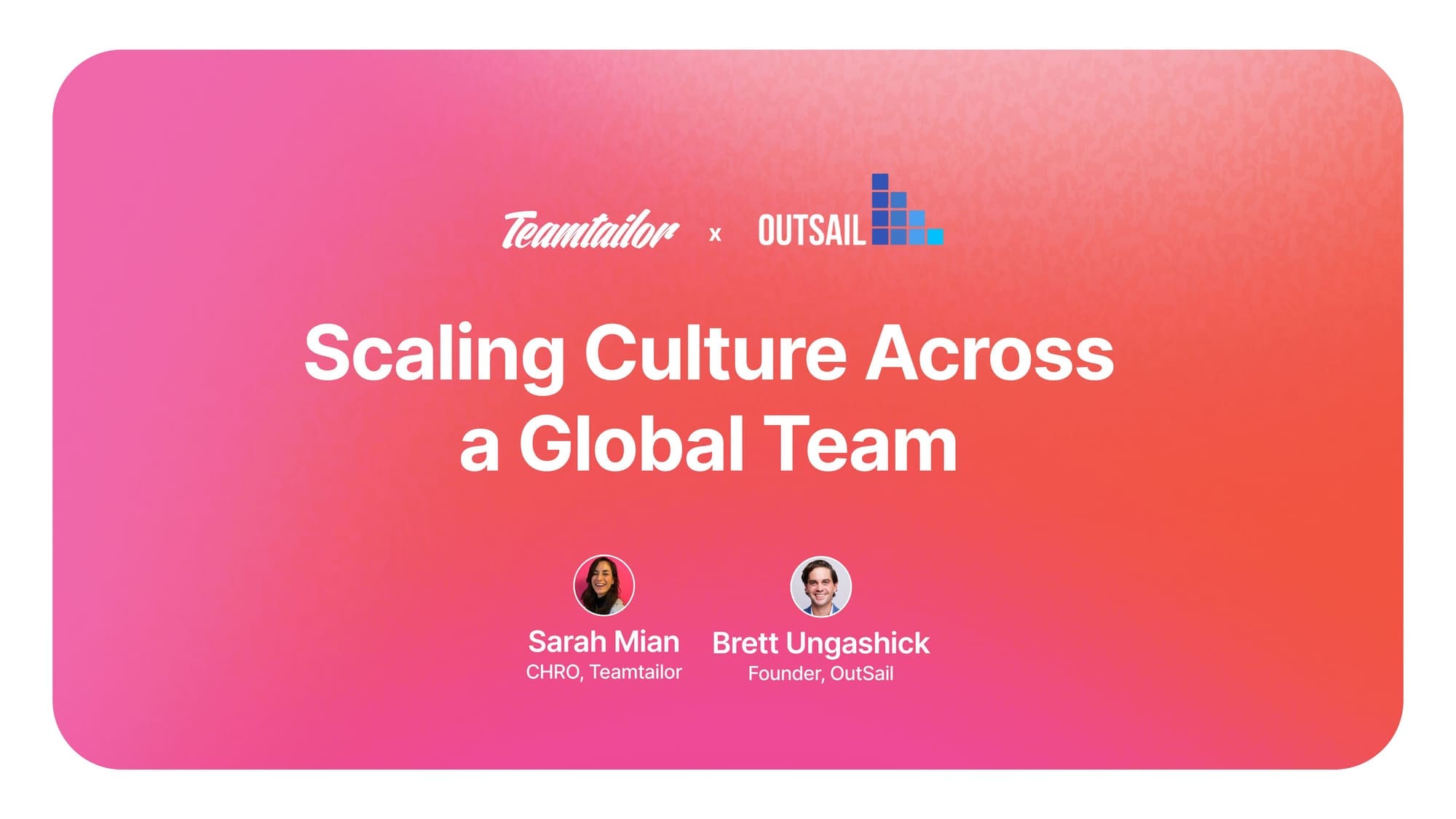
Sarah Mian, our CHRO at Teamtailor, sat down with Brett Ungashick, Founder of OutSail, to talk about what it really takes to scale HR globally with a lean team. Our conversation covered a lot of ground: our lean HR model, the balance between global consistency and local nuance, scaling culture across markets, employer branding in new regions, and the real-world role of AI in HR
Antonio Javiniar
Antonio Javiniar is the Sr. Marketing Manager for Teamtailor in North America.

How do you scale HR globally without ballooning the team?
That is the question a lot of CHROs run into somewhere around the 500-employee mark. The company is expanding into new markets. Culture matters more than ever. Managers need more support. And, at the same time, no one wants to build an oversized central HR function just to keep up.
Most operating playbooks assume you have two options: grow the HR team or accept the chaos.
At Teamtailor, our CHRO Sarah Mian is helping us prove there is a third option.
Sarah joined OutSail founder Brett Ungashick for a practical conversation about what it really takes to scale HR globally inside a 550-person company serving over 12,000 customers across 90-plus countries[1].
Together, Brett and Sarah covered the realities behind a lean HR model: how we structure a small people team, where we build internally versus partner externally, how we balance global consistency with local nuance, what employer branding looks like in markets where people do and do not know us yet, how we scale culture across countries, where AI in HR genuinely helps, and where it still needs a human firmly in the loop.
If we truly want to be a global company, we need to have a global way of doing stuff. Local adjustments matter, but the core has to be the same to create fairness and one team working together. - Sarah Mian, CHRO, Teamtailor
Why is a small HR team the right structure for a 550-person company?
A small HR team is the right structure for a 550-person company when leadership is willing to outsource specialist work, push ownership down to line managers, and accept that proximity to the business beats organizational scale.
At Teamtailor, Sarah runs our HR function with herself and two HR business partners. Three people supporting 550 employees across multiple countries.
On paper, that ratio sounds intense. In practice, it works because the model is intentional.
One of the biggest advantages of staying lean is relational: “the less you are, the less confused it is for managers to know who do I turn to.”
With three clear points of contact instead of a large, layered HR function, managers know exactly where to go. They can build real relationships with HR. Trust compounds. Issues move faster. Coaching becomes more consistent because the same HR voice keeps showing up.
For us, the real question is not “how many HR people should a 550-person company have?” It is sharper than that: which problems should HR solve in-house, and which problems should we buy, borrow, or partner for?
That is where the lean model becomes a strategic choice rather than a headcount constraint.
When should HR build in-house versus partner externally?
HR should build in-house for relationship-based work (leadership coaching, culture, talent strategy, employee experience) and partner externally for jurisdiction-specific specialist work like local labor law, country-specific compliance, payroll, and on-demand learning and development.
Our HR team is mostly based in Stockholm. When a situation comes up in another country, we bring in local labor-law partners on demand.
It is crucial that you have good partners out in each market so that you get support quick.
That architecture matters. We keep the same communication, the same HR processes, and the same internal voice while still getting fast access to country-specific expertise. We build a strong internal core and surround it with the right specialist network.
Brett reinforced the pattern from his work advising HR buyers: as companies move from single-location operations to global or multi-state footprints, “that’s too much surface area for one HR team.”
The better model is to outsource what is not core to your strategy, and concentrate internal headcount on the work that has to come from inside the business.
The build-versus-buy decision for modern HR functions

HR can easily become a world of buzzwords. You can't be everywhere. You connect what you do to the company goals and let everything else be a partnership.
How do you scale HR globally without erasing local nuance?
You scale HR globally by treating the core of the people experience (performance, salary, leveling, fairness mechanisms) as one global system, and letting cultural, leadership, and labor-law adaptations live at the country level.
This is one of Sarah’s clearest principles: if HR is a true strategic function, it owns the global core. If HR drifts into being an admin function, the core fragments by country and managers start improvising.
What happens when HR becomes an admin function, and is not really part of the actual culture and not part of setting processes and structures,” she explained, “is that the managers or the countries will do their own thing and you adapt to whatever is standard in your country.
That is not global scaling. That is the absence of a system.
And it creates the exact problems HR teams are supposed to prevent: pay disparities across markets that have nothing to do with cost of living, performance ratings calibrated differently across regions, and a manager experience that changes depending on which office hired you.
Brett used a Roman Empire analogy that stuck: every province paid taxes the same way, but local religions stayed local. Some things are non-negotiable across the empire. Others should bend. The hard part for any growing company is knowing which is which.
Managers and countries will do their own thing unless HR owns the processes. That's how you fragment fairness without realizing it.
How does employer branding change when you enter a market where no one knows you?
Employer branding changes fundamentally when you enter a market where no one knows you: the recruitment process itself has to do double duty, selling both the company and the category.
In Sweden and much of Europe, as Sarah said, Teamtailor is well known and “employer branding almost comes free because almost everyone uses our product already.”
That is a gift. In high-awareness markets, the brand is already doing a lot of the work before a recruiter ever enters the conversation.
In the US, where our brand is newer, the motion is different. Every recruitment conversation also has to explain what Teamtailor does, why the category matters, and why this is a company worth joining.
That is not just a marketing challenge sitting inside a recruiting process. It is a structural difference in how recruiters need to operate.
That is a lesson for any company entering a new geography. The cost of expansion is not only incorporation, office space, and local salaries. It is also the hidden cost of every recruiter having to do twice the work per hire, sometimes for years, until brand awareness catches up.
How do you scale culture when you are hiring fast across countries?
You scale culture across countries by being explicit about origin: telling new hires where the company came from and by being honest about what is unfinished.
Sarah called out one practice she especially values: Our CEO personally walks new joiners through a “blue presentation” that traces Teamtailor’s journey from five people in a basement to 550 people across multiple geographies.
That moment matters.
New hires meets our founding CEO, hears the Teamtailor origin story in his own voice, and understand that the company they joined did not simply appear fully formed. It was built. The presentation does what an employee handbook cannot: it transfers the emotional weight of the early decisions to people who were not in the room when those decisions were made.
The second mechanism is harder and probably even more important: telling candidates the truth about what is still missing.
We present the gaps as part of the job. We let candidates self-select. We convert the people who are energized by unfinished problems instead of disappointed by them.
The candidates who say yes after hearing that are already culturally aligned. The ones who say no probably would not have been happy twelve months in.
We will not have all the processes, and it will be a bit messy. That's where we need you. That's the pitch. The candidates who hear that and say yes are the ones you want.
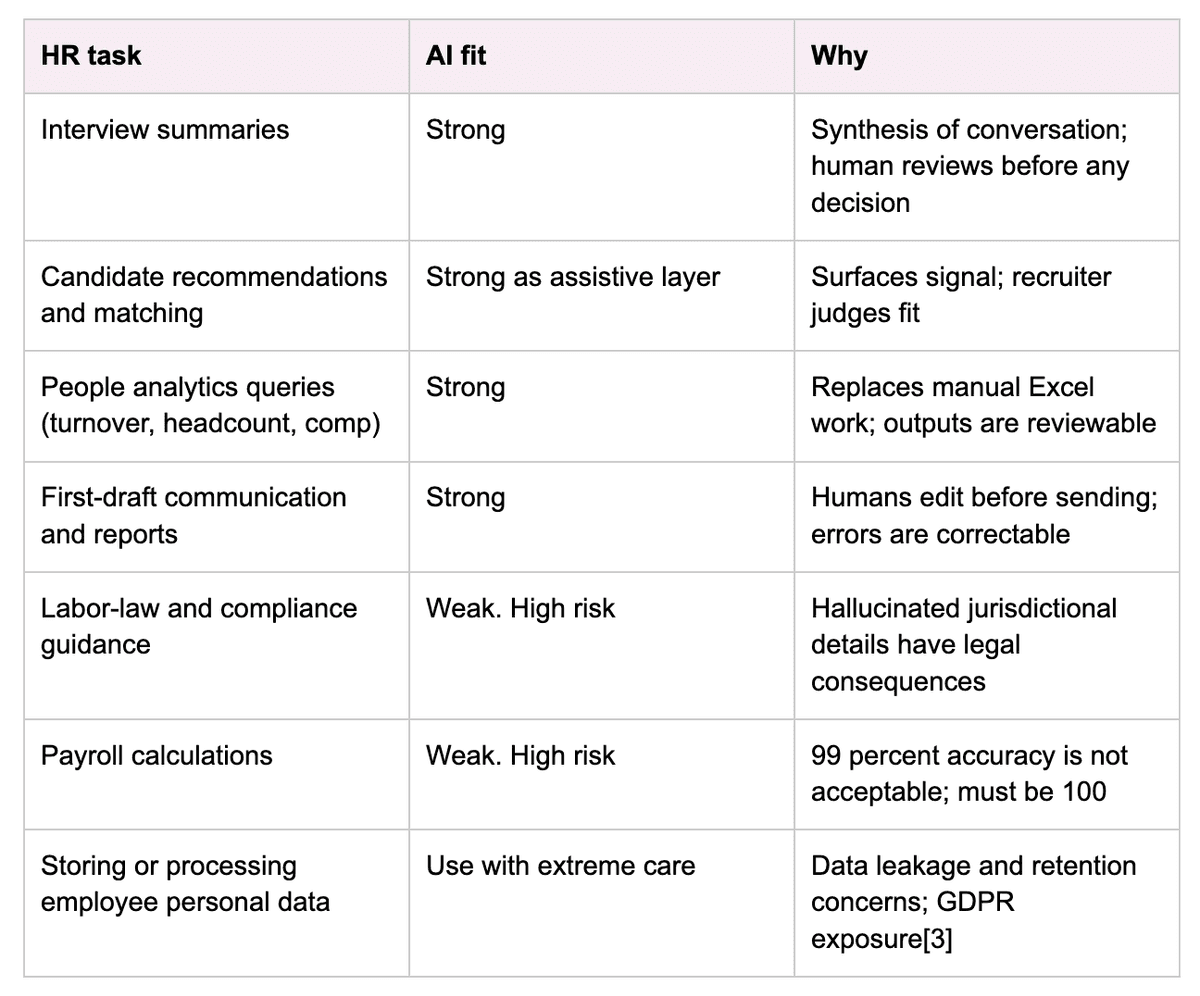
Where does AI actually help HR — and where does it still fail?
AI helps HR in any task where speed and synthesis matter more than absolute accuracy: interview summaries, report drafting, instant analytics queries, candidate recommendations, first-draft communication.
AI fails in HR anywhere the threshold for acceptable accuracy is 100 percent: labor-law guidance, payroll, compliance, and any decision where a wrong answer creates legal, financial, or human harm.
Those are two very real failure modes. First, trusting an AI-generated answer in a domain where being wrong can be catastrophic. Second, feeding sensitive employee or company data into systems where retention and exposure are not fully controlled.
Brett’s framing of the same problem is worth keeping: “HR and especially payroll and compliance are some of the safest areas in the white-collar workforce right now, just because 98 percent accurate is not going to be okay. 99 percent is not. 99 and a half is not. It has to be 100.”
That is the line. In categories where the marginal harm of one error outweighs the average benefit of automation, AI should augment humans rather than replace them.
Where AI earns its place in HR and where it does not
What does it take to scale HR globally in 2026 and beyond?
To scale HR globally in 2026 and beyond takes a small in-house team focused on strategic and relational work, a network of specialist partners for jurisdictional expertise, and an AI layer that compresses administrative work.
Sarah’s experience reflects where we believe the future HR function is heading: small, specialized, partnered, AI-augmented, and oriented around relationships rather than administration.
The era of HR teams trying to be experts in every sub-discipline is over for most growth-stage companies. The economics no longer support it. The expertise required is too jurisdictional, too fast-moving, and too varied for any one team to hold internally.
What replaces it is a three-layer model.
- A small in-house team focused on the strategic, relational, and uniquely internal work: leadership coaching, culture, employer experience, and the global core of performance and compensation.
- A network of specialist partners: local labor law, payroll providers, executive coaches, L&D consultants brought in when the work demands it.
- An AI layer that compresses the administrative tail of the job: summaries, drafts, queries, recommendations, reports.
For HR leaders trying to scale global HR operations, the takeaway is clarifying. The work is not to become an expert in everything HR could possibly include. The work is to decide what HR uniquely owns inside your company, build for that, and consciously offload the rest.
It is to define the global core and let local nuance flex around it.
Our bet at Teamtailor (and the bet of any company scaling globally without scaling its HR function in lockstep) is that talent-led growth requires this kind of discipline.
You do not hire your way out of structural problems. You design for them. You decide what you are going to be excellent at, you decide what you are going to buy, and you let your people compound impact in the work only they can do.
Ready to become the next HR Hero?
References
[1] Teamtailor — company overview, customer base and geography
[2] Teamtailor product features — AI Co-pilot, ATS, employer branding
[3] Teamtailor — security, data protection and GDPR compliance
[4] Sarah Mian — Chief HR Officer, Teamtailor (career page)
[5] Brett Ungashick — founder of OutSail (HR software advisory)