

What an applicant tracking system is, and what changes past 500 people
An applicant tracking system (ATS) is the one place where the hiring actually happens: the job, the candidates, the stages they move through, the interviews, the decisions and the record that is left afterwards. When it works, a recruiter opens one board in the morning and knows who is waiting for whom. When it does not, the real process lives in a spreadsheet, an inbox and the memory of one person who is on holiday.
This guide is about the category, written by a company that makes one. Where we describe how something works, we describe how it works in Teamtailor and say so. Where a requirement applies to every vendor, we say that too.
Five things that change
Below a few hundred employees, one team can agree on one way of hiring. Past a few hundred people that stops being possible, and the system has to carry the differences instead of flattening them. Five things change.
- Several legal entities and brands. A candidate applying to the hotel in Lisbon should land on that brand's career site, not on the group's.
- Several countries. Each has its own privacy rules, retention periods and, in some, a works council that wants to see how candidate data is handled before anyone signs.
- Volume. One role that draws four hundred applications makes the shared inbox impossible, and the thread with the hiring manager that two people are copied on and one of them reads stops being a joke.
- Governance. Who may publish a job, who may see salary data, who approved the requisition, and who can prove it a year later.
- Procurement. A security questionnaire, a data processing agreement (DPA), sometimes a legal review in two languages.
The requirements in this guide are set at the bar a company of 1,000+ employees applies. They serve the smaller buyer as well, who will meet the same questions a little later.
Prices, certificates and legal dates change. Every figure in this guide carries a marker that points to the source list at the end of the page, and the dates are the ones the sources gave on 20 October 2026.
How an ATS works, step by step
The clearest way to see what an ATS does is to follow one role from request to first day. This is how that runs in Teamtailor. Other systems order things differently, but the same seven jobs have to be done somewhere.
1. The requisition and the ad
The role starts as a request, and the approval happens inside the system, not in a mail thread. A hiring manager submits the job as pending, a recruiter or an approver releases it, and the trail shows who said yes. The ad is drafted from a few lines about the role and then edited by a person. One publish sends it to the career site and the job boards, and the career site itself is built inside the ATS, so the ad, the form and the pipeline share one set of data.
At scale, the approval chain is where the enterprise angle sits: a requisition for a role in one country may need a finance sign-off, while the same role elsewhere does not. The system has to hold both.
2. The applications
People apply without creating an account, and they do it from a phone, often on the bus. Someone who is not ready to apply can connect instead, leaving contact details so the team can come back when a fitting role opens. Both routes end up as candidates on the same board, which is what makes the talent pool worth anything later.
3. Screening
Screening questions are set per job: right to work, a licence, shift availability, a language. Triggers then do the routine part. A trigger can move a candidate to a stage, send a message or prompt a recruiter to look, depending on how the team set it up. What is automatic is what the team configured, and nothing else.
4. Stages and the people in them
Every candidate sits on one board, in a stage. Around the person, and not around the email, the team keeps comments, to-dos, shared candidates and reminders. A hiring manager who opens the system once a quarter for one panel sees the same board the recruiter sees, narrowed to their role, and does not need a training session to find the next action.
5. Interviews
Scheduling runs against the interviewers' calendars, so nobody trades twelve emails to find an hour. Interview kits give everyone on the panel the same instructions, the same questions and the same scorecard. The point of that is comparison: the team compares candidates against each other on shared criteria, rather than comparing interviewers' moods.
6. Decision, offer, first day
Evaluations sit side by side when the panel meets, so the discussion starts from what each person wrote down before they heard the others. The offer is signed electronically through an integration. Before day one, the new hire gets onboarding tasks, and the handover to the HR system carries the details across.
7. Afterwards
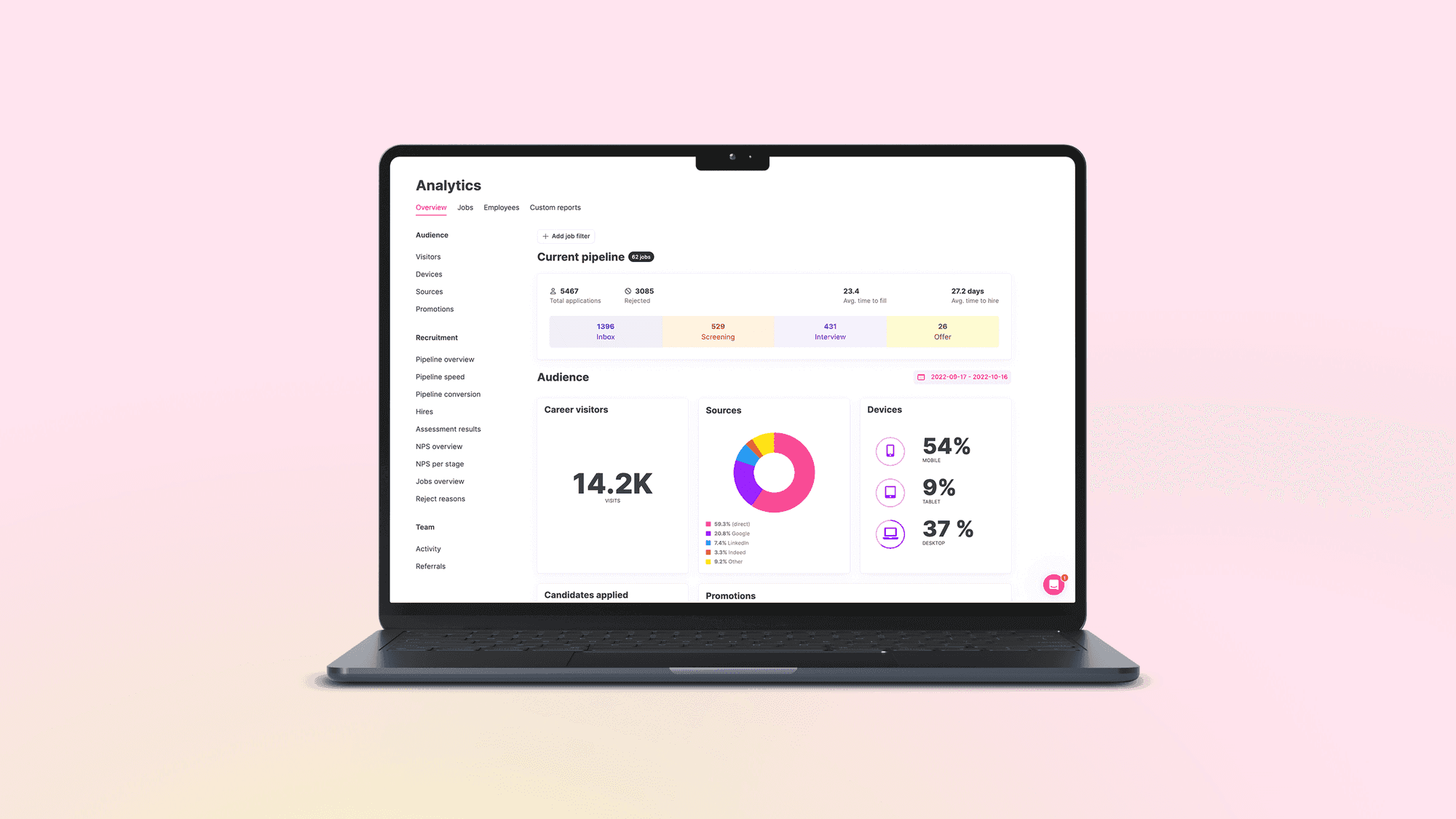
The people who did not get the job do not disappear. With consent, and with a retention period that follows the country they applied in, they stay in a talent pool for the next opening. Analytics close the loop: time to hire, source of hire, stage conversion and drop-off, for one role or for the whole group. Those are the numbers the head of TA takes into the budget meeting, and they only exist if the process ran through the system.
ATS, recruitment CRM, HRIS, talent suite: which is which
The labels overlap, and vendors use them loosely. Used strictly, they describe where a system starts and where it stops, which is the thing a buyer needs to know when two systems have to hand over to each other.
| Term | What it is | Where it starts and stops |
|---|---|---|
| ATS | The system that runs the hiring process for a job: applications, stages, interviews, decisions, the record. | Starts when a role is requested. Stops at the signed offer, when the candidate becomes an employee. |
| Recruitment CRM | Relationship tools for people who are not yet applying: talent pools, outreach, events, nurture. | Starts before there is a job. In Teamtailor it is part of the same system, so a contact and an applicant are one record. |
| HRIS | The employee record: contracts, pay, absence, org chart, reporting. | Starts on day one. The ATS hands over to it. Teamtailor integrates with Workday, SAP SuccessFactors and Personio.[S12] |
| Talent suite or talent acquisition platform | An ATS plus modules for onboarding, performance, learning or compensation, often from an HRIS vendor. | Spans several stages of the employee lifecycle. One contract and one vendor is the upside. The recruiting module is rarely the part the vendor is proudest of, so test it on real roles before you accept it as part of the bundle. |
| Recruitment software | The whole category, from job posting tools to full platforms. | No fixed boundary. Treat it as a search term, not as a requirement. |
Where the HRIS boundary sits
In an enterprise, the rule that keeps this clean is simple: the ATS owns the candidate until the signed offer, and the HRIS owns the employee from then on. The integration is the handover of a short list of fields: name, start date, salary, manager and cost centre. Get those five agreed between TA and HR before the pilot, because most delays in a rollout are an argument about who owns a field.
The integration list is worth reading for what is on it and also for how it runs: whether the handover is triggered by a stage change, whether failed records are visible to the recruiter, and who gets the error. Ask to see it run on a real hire.
What candidates see
The candidate sees a career site that loads quickly, a form that can be finished on a phone, a reply within days and a clear idea of what happens next. That is the part of the ATS your brand is judged on, and it is also where applications are lost without anyone noticing.
Phones carry more of this than many teams assume. In Teamtailor's hospitality benchmark, 46.9% of applications came from a phone.[S30] In retail it was 64.1%.[S31] Both figures are activity recorded in Teamtailor by its customers, so they describe those industries on this platform and not every employer. For an enterprise recruiting across shifts, sites or frontline roles, a form that only works well at a desk is a form that loses part of the pool.
Replies, and what comes next
Most of what a candidate remembers is tone and timing. A message that says what happens next and when, even when the answer is no, costs a template and a trigger. Teamtailor includes a candidate survey and a candidate NPS, because you cannot improve what you do not measure, and because the people best placed to say how it felt are the ones who went through it.
What is automatic and what is not. Teamtailor does not score CVs on its own. Automation such as Smart move acts only on conditions a recruiter sets, and those can include CV keywords[S35]. The recruiter reads what was sent. What happens automatically is what the team configured in triggers, and the team can see it.
Several brands, one candidate
A candidate who applies to one brand of a group should see that brand's career site, its voice and its privacy notice, not the group's ATS. In a multi-brand set-up, this is a requirement and not a cosmetic choice: the applicant has agreed to something specific, with a specific legal entity. How the platform separates brands is covered in the next section.
The enterprise requirements
The security reviewer starts in the trust centre, where the certificates and reports are already published. The hiring manager in Lisbon logs in with the company account and never sets a password. The new entity in Poland opens its own career site, and the group's reporting still adds up. That is what a system built for enterprise buying looks like once it is running, and the table below is the checklist that gets you there.
Read it left to right: the requirement, why it matters at 1,000+ employees, what to ask any vendor, and where Teamtailor stands, with the source.
| Requirement | Why it matters at 1,000+ | What to ask the vendor | Where Teamtailor stands |
|---|---|---|---|
| Single sign-on (SAML 2.0) | One identity per person, access removed when they leave, no password reset queue. | Which identity providers are documented? Can SSO be enforced? Is it available per group of accounts? | SAML 2.0 SSO, set up under Settings, then Security. Guides exist for Microsoft Entra ID, Okta, OneLogin and Google. When SSO is enforced, password login is disabled. A parent account can run one setup for a group (Group SSO).[S5] |
| User provisioning (SCIM) | Joiners, movers and leavers are handled by IT, not by a recruiter remembering. | Which providers is it tested with? Users only or groups too? Who issues the key? | Tested with Microsoft Entra ID and Okta. User objects only, groups are not supported. The key is issued by your Teamtailor contact.[S6] |
| Roles and permissions | A hiring manager should see their role and nothing else. Salary data needs a narrower circle. | How many roles? Can a hiring manager publish? Can roles be limited to one division? | Six standard roles and two that depend on an add-on: No Access, Default User, Hiring Manager (submits jobs as pending, cannot publish), Recruitment Lead, Recruitment Admin, Company Admin, Division Admin (only with Divisions) and External Recruiter (add-on).[S8] |
| Audit log | Proof of who did what to candidate data, for your DPO and for a regulator. | Is it on by default? How long is it kept? Can it be exported? What is the extra cost? | Activated on request by a Company Admin and may carry an extra cost. Under Settings, then Data & Privacy. Kept 15 days by default, 30 days at most in the settings, longer retention at extra cost. If your policy asks for a longer trail, agree it in the contract.[S7] CSV export. Events include candidate creation, updates, deletion, removal requests and data requests. Nothing before activation is visible.[S7] |
| Data location | Some works councils and public-sector buyers ask where candidate data sits before they ask anything else. | Which regions? Where is it stored, where is it processed? Do regions share data? | The customer chooses. Europe (stored with AWS Ireland, processed mainly inside the EU/EEA), North America (AWS Oregon, processed in the US), Asia-Pacific (AWS Australia). The regions operate separately, and no data is transferred between instances.[S4] |
| Retention, consent, deletion | Retention periods differ per country, and a deletion request has a clock on it. | Can retention rules differ by country? Does deletion remove data from backups, and when? | Data & Privacy settings cover retention rules, candidate permissions and consent requests, automatic data removal, cookie consent on the career site, settings localised by candidate location, and a Privacy Manager role.[S33] Deleted data is removed from the account at once and remains only in backups for their retention window.[S11] |
| Several brands and entities | Separate legal entities need separate career sites, notices and sometimes separate data. | How is separation done? Is data shared? Can a group still report across entities? | Three structures: one account; one platform with several career sites using Divisions (shared by default, selective separation, an own career site per division, a Division Admin role); or the Group solution, where a parent account connects separate child accounts, each with its own branding, settings and processes, no data shared between them, plus Group SSO and Group Analytics.[S9][S10] |
| Integrations and API | The ATS sits between the career site, the HRIS, e-signing and background checks. | Which HRIS integrations are native? Is the API open? Who maintains connectors? | 550+ integrations, including Workday, SAP SuccessFactors and Personio, plus e-signing, assessment and background-check providers.[S12] Open API.[S12] |
| Analytics and reporting | The head of TA needs one number per entity and one for the group. | Can custom reports be shared without an export? Can group data be combined? | Time to hire, source of hire, stage conversion, apply rate and drop-off, and custom reports that are shared without exporting. Group Analytics covers the Group solution.[S9] |
| Users and seats | Per-seat pricing quietly stops hiring managers from getting access. | Are users limited? Are job postings limited? Is the price per seat? | Unlimited users and unlimited job postings. Pricing is per organisation, not per seat.[S13] |
| Support | A hiring manager who cannot find a button on a Monday morning is not going to wait for a ticket. | Who can contact support? Is there a named contact for large accounts? | Live chat for every user, regardless of access level, and dedicated Customer Success Managers.[S12] |
| Accessibility and languages | Career sites and application forms fall under accessibility law in many markets. | Is there a conformance statement against WCAG? Which languages does the candidate flow cover? | The European Accessibility Act applies from 28 June 2025, to services including websites.[S34] Ask Teamtailor, as any vendor, for the current WCAG conformance statement through the trust centre. |
The audit log row is the one worth reading twice. The default retention is short, and longer retention costs extra, so the question for your security team is not whether the log exists but how far back it has to go.
Questions for the security reviewer
- What is the date and scope of the latest SOC 2 Type 2 report, and were there exceptions?
- Which entities and products does the ISO certificate scope cover, and when was the last surveillance audit?
- Where is the sub-processor list, and how much notice do we get before it changes?
- Which data region will we be in, and what is processed outside it?
- What are the retention defaults, and can they differ by country?
- How long is the audit log kept, and what does a longer period cost?
- Can SSO be enforced for every user, so that password login is off?
- Does SCIM deprovisioning remove access immediately, and what happens to the candidate data the user owned?
- How often is the application penetration tested, and can we see a summary?
- How quickly does the DPA require you to notify us of an incident?
Security certificates, read for a buyer
The security reviewer finds, in one document, the name of each standard, what it covers, what it leaves out and the date of the last audit. Most certificates say less than their badge implies, so each entry below gives what it certifies, what it does not, and what to ask for.
- ISO/IEC 27001
- Certifies an information security management system (ISMS): the policies, the risk process and the controls, audited by an accredited body. Certificates run three years, with annual surveillance audits.[S22] It does not say the product is free of bugs. It says the organisation manages security in a controlled way. Ask for the certificate, the scope statement and the date of the last surveillance audit.
- ISO/IEC 27701
- The privacy extension to ISO/IEC 27001, a privacy information management system (PIMS). It maps to the duties of a GDPR controller and processor.[S23] Ask whether its scope covers the product you are buying.
- ISO/IEC 27017 and ISO/IEC 27018
- Cloud-specific security controls (27017)[S24] and protection of personal data in public clouds where the provider acts as a processor (27018).[S25] They are usually held by the data-centre provider, not by the software vendor. Ask who holds them.
- ISO 22301
- Business continuity management.[S26] It is the certificate for the question of what happens when the data centre burns. Ask for the recovery targets in the contract, not only for the badge.
- ISO/IEC 42001:2023
- The first management-system standard for AI, published in December 2023.[S27] It certifies how an organisation governs the AI it builds and buys (risk assessment, roles, monitoring), not the model itself.[S27] It is relevant to readiness for the EU AI Act. Ask what the scope is and who audited it.
- SOC 2 Type I and Type II
- An attestation report under the AICPA Trust Services Criteria, and not a certificate. Type I describes the controls at a point in time. Type II tests that they operated over a period, typically six to twelve months.[S28] Ask for the Type II report, its period and any exceptions listed.
- CSA STAR
- The Cloud Security Alliance's registry, built on its cloud controls matrix, either self-assessed or certified.[S29] Ask which level the vendor holds, since the two carry very different weight.
- GDPR and the DPA
- GDPR is a law and not a certificate. "GDPR compliant" on a website means nothing until you have read the data processing agreement, the sub-processor list and the transfer mechanism.
What Teamtailor holds
| Standard | Status | Where to get the document |
|---|---|---|
| ISO/IEC 27001 and ISO/IEC 27701 | Certified, for the Teamtailor ATS and Aboard HR (ISMS and PIMS).[S1][S2] | Trust centre |
| SOC 2 Type 2 | Audited annually; report available in the trust centre.[S1][S2] | Trust centre |
| ISO/IEC 42001:2023 | Listed in the trust centre's compliance section.[S1] | Trust centre |
| GDPR | DPA, sub-processor list and GDPR FAQ published.[S1] | Trust centre |
| Data centres | Certified ISO27001, ISO27017, ISO27018, ISO27701, ISO22301 and CSA STAR CCM v4, per the terms.[S11] | Terms and conditions, appendix on technical and organisational measures |
| Encryption in transit | All communication is encrypted with at least TLS 1.2.[S11] | Terms and conditions, appendix on technical and organisational measures |
| Other controls | The trust centre also lists MFA, role-based access control, application penetration testing, anti-DDoS, data backups, an incident response plan, an IT continuity plan, an SLA statement and the sub-processors for the EU region. Ask for the document behind each one: the page names the control, not the figures.[S1] | Trust centre |
The documents are at trust.teamtailor.com. The last row is a list of headings from the trust centre, so ask for the underlying document behind each one.
Rules that touch the ATS now
The compliance lead gets a list of the four rules that change what an ATS must do, with dates, and does not have to learn them from a vendor's marketing. This is a summary for orientation and not legal advice. Check dates against the sources.
| Rule | What it asks of recruiting | Date | What the ATS has to do |
|---|---|---|---|
| GDPR | A lawful basis and consent for candidate data, retention limits, answers to data requests and deletion, records of processing. | In force | Retention rules, consent handling, deletion that works and an audit trail.[S33] |
| EU AI Act, Regulation (EU) 2024/1689[S20] | Recruitment and selection systems are high-risk under Annex III point 4. As a deployer, the employer must inform candidates, keep human oversight, keep logs, and use the system as instructed. | After the Digital Omnibus (Regulation (EU) 2026/1744, in force 27 July 2026), high-risk obligations for Annex III apply from 2 December 2027.[S20] Transparency duties in Article 50 have applied since 2 August 2026.[S20] | Show candidates when assistance is used, keep a person in the decision, keep logs that the employer can read. |
| EU Pay Transparency Directive, Directive (EU) 2023/970[S21] | Candidates get the starting pay or pay range before the first interview. Employers may not ask about pay history. Gender pay gap reporting for employers with 250 or more workers.[S21] | Transposition deadline 7 June 2026.[S21] Reporting from 7 June 2027.[S21] Member states may go further.[S21] | A pay field on the job, templates without a salary-history question, an export for reporting. |
| European Accessibility Act, Directive (EU) 2019/882[S34] | Services including websites must be accessible. Career sites and application forms are in scope where national law applies it. | Applies from 28 June 2025.[S34] | Accessible forms and career sites, and a WCAG conformance statement you can ask for. |
For the AI Act, Teamtailor publishes Responsible AI Principles and an AI Act page in its trust centre.[S1] The assistance in the product produces drafts and suggestions in front of a person. The person decides, and the system does not.
The pay transparency point is the one that most often changes a template. A job without a pay field and a screening form with a salary-history question both need to change before the deadline, not after the first complaint.
Where the assistance fits
The recruiter ends the day with a first draft where there used to be a blank page, and has still made every decision herself. That is the useful shape of the assistance in an ATS: it handles the first pass, and a person handles the judgment.
In Teamtailor, the system does these things:
- drafts a job ad from a few lines about the role;
- summarises a CV and a video interview;
- suggests interview questions for the role;
- answers scorecard questions from the interview transcript;
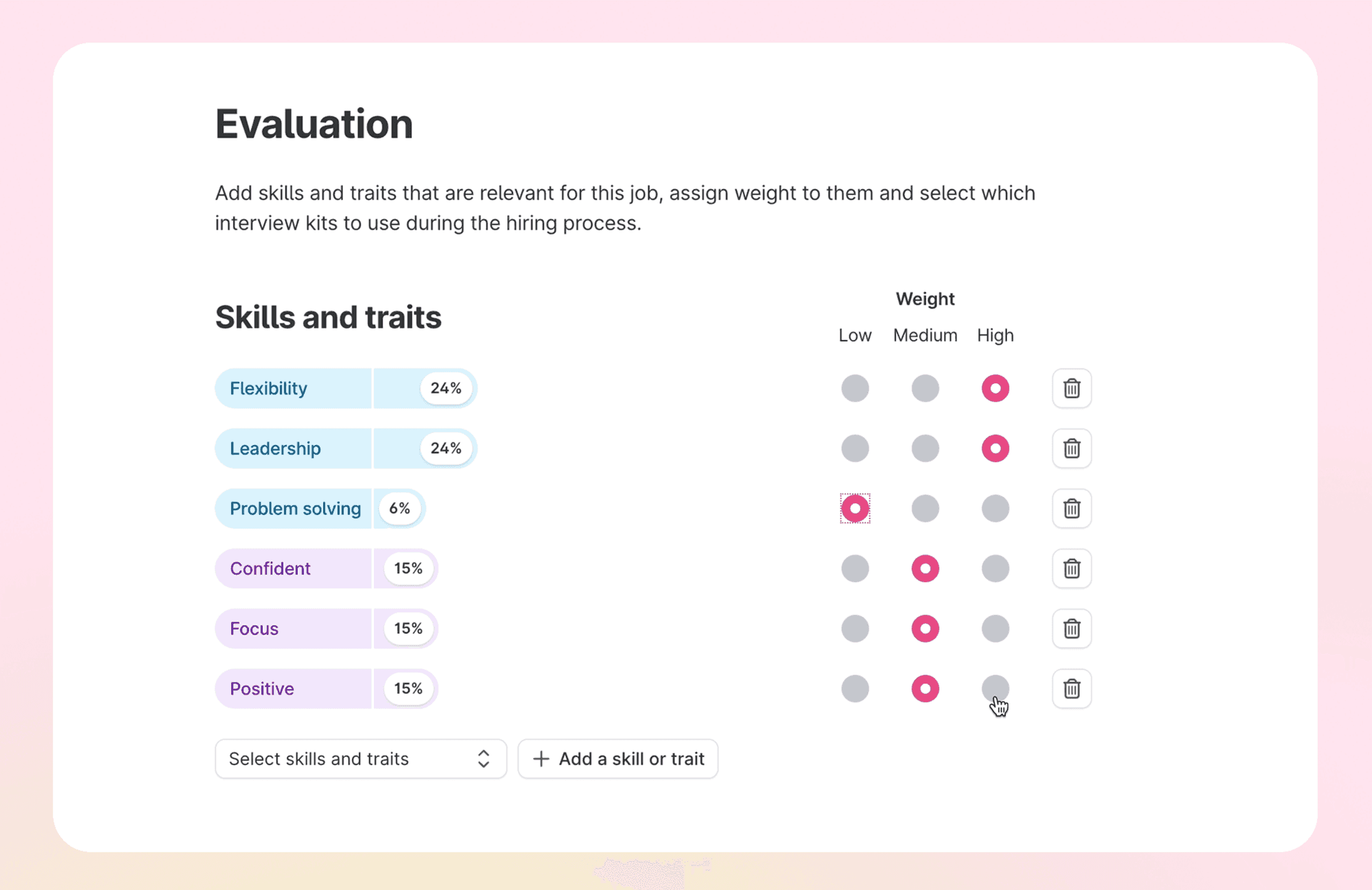
- evaluates candidates against criteria the team set;
- surfaces people from the talent pool who match a new opening.
Each of these is a draft or a suggestion in front of a person. The team reads the summary and decides whether it is right. The criteria for an evaluation come from the team, so the logic is theirs and not a hidden score.
That is also the shape the law asks for. As a deployer under the EU AI Act, an employer informs candidates, keeps human oversight and keeps logs. A system that suggests and a person who decides makes oversight a normal part of the day, not a separate process.
What to ask the vendor
If a vendor says the system will decide for you, ask to see it decide. Then ask who is accountable when it is wrong, and where in the product that person can see why.
Choosing and buying at enterprise scale
By the time the contract is signed, the team has a shortlist of three, a security review that was done in order, and a pilot that used real roles. It takes longer than a quick demo, but not as long as replacing the wrong system in two years.
That second case is not rare. Aptitude Research found that 1 in 4 companies were replacing their ATS in 2025, that 82% say their current system has significant functionality gaps, and that nearly half of enterprise companies run more than one ATS.[S17]
The process
- Requirements. Use the table in the enterprise section as the checklist. Mark each row must-have or nice-to-have before any vendor sees it.
- Shortlist. Three vendors, not nine. A longer list means you read marketing and not documentation.
- Security review. Start from the trust centre and use the questionnaire for what the trust centre does not answer.
- Pilot. Real roles in one entity, with the hiring managers who will use it, long enough to include a full hire.
- Contract. The DPA, the SLA, and the exit: a data export in a usable format, and what happens to the data afterwards.
How vendors charge
Pricing is the part of the buying process that is most often hidden. Public price lists are rare because vendors quote per company, and the same applies to Teamtailor: the pricing page takes a few details and a person comes back with a figure for your organisation.[S13] What the model contains is worth comparing before the number.
| Model | What you pay for | What to watch |
|---|---|---|
| Per seat | Each user who logs in. | Hiring managers get dropped to save cost, and the system ends up used by the recruiters alone. |
| Per company, by headcount | A fee based on employees or on hiring volume. | How the headcount is counted, and what happens when you acquire a company. |
| Per module | Core, then each add-on module separately. | The module you assumed was included, such as analytics, e-signing or the career site. |
| Implementation fee | Set-up, migration and training, once. | Whether configuration of roles and templates is in scope, and whose hours go over. |
| Add-ons | Audit log retention, external recruiter seats, premium support. | Features your security team needs that sit outside the base price. |
In Teamtailor, users and job postings are unlimited, and the price is quoted per organisation.[S13] The add-ons in the table above exist in Teamtailor too: the audit log extension and the external recruiter role are two of them.[S7][S8]
What an implementation looks like
| Phase | What happens | Who is in the room |
|---|---|---|
| Discovery and data migration | Process mapping, what to migrate, what to retire. | TA lead, vendor project lead, data owner. |
| Configuration | Pipelines, templates, roles, triggers, career site. | TA operations, a recruiter per region, brand owners. |
| Integrations | SSO, HRIS, e-signing, job boards. | IT, HRIS owner, vendor integration contact. |
| Pilot entity | Real roles in one entity, adjusted from feedback. | Pilot recruiters and hiring managers. |
| Rollout by country | Entity by entity, with local privacy settings. | Regional TA champions, local HR, works council where needed. |
The weeks depend on the number of entities and integrations, so the honest answer is a range rather than a number. Two examples show it. Five Guys, with 1,700+ restaurants, had everything finalised in eight weeks from signature to launch.[S16] Knauf unified recruitment for 43,500 employees over a two-year programme, with more than twelve regional TA practitioners as champions, and saw more than a 50% increase in applications through its career sites over three years.[S14]
Measuring the result
The head of TA walks into the quarterly review with five numbers, each defined the same way in every entity, and each compared with a benchmark that says where it comes from. That is a smaller set than most dashboards offer, and it is enough to show whether the system has changed how the team works.
| Metric | Definition | What a benchmark says | Source |
|---|---|---|---|
| Time to fill | Calendar days from the approved requisition to an accepted offer. Teamtailor's own report counts from the day the job is published until the candidate is moved to Hired.[S36] | Median 39 calendar days for nonexecutive roles.[S19] | SHRM, 2026 |
| Time to hire | Calendar days from the candidate's application to the accepted offer. | Median 18.7 days among Teamtailor hospitality customers.[S30] This is activity recorded in Teamtailor by its customers, not an industry estimate.[S30] Rocco Forte Hotels: 28 days on average, across 43,200 applications.[S15] | Teamtailor benchmark; customer story |
| Cost per hire | Total recruiting cost divided by hires. Definitions differ, notably on whether internal time is counted. | Average $5,475 for nonexecutive and $35,879 for executive roles, in a survey of 2,371 members.[S18] | SHRM, 2025 |
| Source of hire | The channel the hired person came from. | In retail, sourced candidates were hired at 12.96% against 0.67% of inbound applications, while inbound still produced 73% of hires.[S31] | Teamtailor retail benchmark |
| Hiring-manager response | Whether hiring managers act on candidates in the system. | In retail, 70.3% were hired within 90 days when two managers were active on the job, against 48.5% with none.[S31] | Teamtailor retail benchmark |
| Apply completion on phones | Share of applications that come from a phone. | 46.9% in hospitality[S30] and 64.1% in retail.[S31] | Teamtailor benchmarks |
Two of these figures come from one platform's customers, in two industries, and the others from survey data on a different population. Do not average them. Use them to see roughly where you sit and to ask better questions.
These numbers only mean something if the whole process ran through the system. A time-to-hire figure that starts at the application and ends at an offer signed in a PDF outside the ATS describes the part you can see. Settle the definitions before the pilot, write them down and use the same ones in every entity.
Teamtailor as an enterprise ATS
This is the short version, with sources, for the reader who skipped to the end. Teamtailor is an applicant tracking system with the pipeline, the career site, interview kits, the talent pool, triggers, analytics and the assistance described above in the base product.
- Unlimited users and unlimited job postings, quoted per organisation.[S13]
- 550+ integrations, live chat for every user and dedicated Customer Success Managers.[S12]
- ISO/IEC 27001 and ISO/IEC 27701 certified, and a SOC 2 Type 2 report, available through the trust centre.[S1]
- Three data regions: Europe, North America and Asia-Pacific.[S4]
- Divisions (a premium add-on) and the Group solution for several brands and entities.[S9]
Customers include Knauf, with 43,500 employees on one platform,[S14] Rocco Forte Hotels[S15] and Five Guys.[S16] Their stories are the clearest proof of how the system holds up in practice, and they say more about it than we can.
Two plain next steps: Book a demo or See pricing. Teamtailor can also be read next to the systems you are probably looking at, on the comparison pages. For a shorter definition, see the glossary entry, the product page and the enterprise page, or the integrations list.